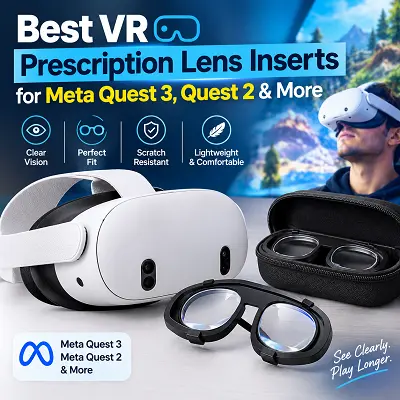
There are various challenges that those who wear glasses can encounter when using VR headsets. Glasses may become squeezed by the headset, have limited room near the eyes of the user or cause difficulties in achieving a perfect fit. Taking off glasses is not always a viable solution due to the inability of people with prescription vision to perceive VR environments in clear view. Therefore, Best VR Prescription Lens Inserts provide people with the opportunity to use virtual reality devices without having to wear regular glasses. These inserts include magnetic attachments, protective coating, and storage equipment besides the lenses themselves.
Selecting appropriate lens inserts requires taking into account the compatibility with VR headsets as well as other aspects of choosing this device. Incompatibility of optical system used in headsets makes lens inserts from one device unfit for other devices. Some of such devices include Meta Quest 3, Quest 3S, Quest 2, Valve Index, HP Reverb G2 and PlayStation VR2. Other criteria are also important including prescription strength, quality of lenses, installation and comfort.
What Are VR Prescription Lens Inserts?
The VR prescription lens inserts are corrective lenses inserted into the virtual reality headset. The lenses are fabricated based on a prescription of an individual’s vision and placed in front of the optics of the built-in headset.
This way, instead of wearing glasses under the headset, people will look at the inserted prescription lenses in order to make the experience easier for those individuals with vision correction needs.
How VR Prescription Lenses Insert into the Headset Work
In general, there are two prescription lenses attached to the mountings in order to provide correct viewing through the optics for the user. The mounting keeps the lens in the right place in order to provide correct vision of the virtual display.
Based on the type of the insert system, these can be installed via clips, snap-in or magnetic bases. In some cases, it is possible to remove the prescription lenses without the removal of the mounting base.
What Makes Them Different from Normal Glasses
Normal glasses stay on the nose and ears, while the prescription insert stays inside the headset. It helps reduce pressure from the arms and frames of glasses during the game.
Other possible advantages could be:
- Low contact of eyeglass frames with the facial interface of the headset.
- Prevention of scratch from regular glasses on the headset optics.
- Easier fitting of the headset for those who wear glasses that are wide or thick.
- The possibility to take off the correction lenses in case another person uses the headset.
This depends on the quality of the fit, design of the insert and the prescription of the person using the device. Inserts have to be cleaned regularly since fingerprints, dust and sweat could affect the picture.
For users who also want to improve headset comfort, comparing the best VR face covers can help them understand the available facial-interface options. Face covers and prescription inserts serve different purposes, so compatibility and fit should be checked separately.
Can They Correct Myopia and Astigmatism?
Yes, many prescription inserts provide myopia correction, known as nearsightedness, as well as astigmatism. Myopia correction provides better visibility of distant virtual objects, whereas astigmatism correction is related to the problem of uneven focus caused by the shape of the eyes.
The producer should provide the support for the prescribed range of vision. Those who have high prescriptions or unique cylinder numbers should check the compatibility first..
How Do VR Prescription Lens Inserts Work?
Corrective lenses cause light rays to converge at the proper focal point within the eye. The inserts will interact with the optical setup of the VR headset to produce a more focused image of the virtual display screen.
How a Prescription Fixes Vision In a VR Headset
A prescription will consist of various numbers:
- Sphere: This number tells you how much correction is needed for myopia or hyperopia.
- Cylinder: Number of diopters necessary to correct the astigmatism.
- Axis: Direction of the astigmatism correction (in degrees).
- ADD: An extra number necessary for some multifocal prescriptions, though most vendors of VR inserts sell only distance lenses for the majority of cases.
Enter all the numbers as listed in your current prescription when making your order. Note that not all manufacturers will accept any prescriptions.
The Importance of Proper Lens Placement
It is crucial that the inserts are placed according to the optical system of the headset and the user’s eyes. The incorrect placement, incorrect frame, and wrong prescription will cause blurring, reflections, and discomfort.
If the blurring occurs even after correct installation, make sure that the lens is correctly seated in the headset.
Can VR Prescription Lens Inserts Be Used With All Headsets?
No. Compatibility depends on the specific headset model and design of the lens inserts’ mounting. Even from one manufacturer, headsets can have different optical systems and different frames.
Meta Quest 3 and Quest 2
Model-specific inserts are required for both Quest 3 and Quest 2. These models have different lens assemblies and mounting systems, which means that users should not assume that inserts for the Quest 2 will work with the Quest 3.
Users should also pay attention to the specific product listing when purchasing inserts for Quest 3S. While this model uses some of the accessories as other Quest models, it has a different optical system compared to the Quest 3.
Valve Index and HP Reverb G2
Valve Index prescription inserts are made with the optics and mount of the Index in mind. HP Reverb G2 inserts must work with that specific headset in the same way.
Make sure to purchase these accessories from a supplier who mentions the exact headset in their product description. Check inventory before placing an order for an older headset.
PSVR2 and Other Headsets
Since PSVR2 uses its unique optical system, it needs special prescription inserts. Other headsets can also require a dedicated solution depending on the manufacturer and headset model.
Choose the exact headset first in the product menu.
Can You Use VR Prescription Lens Inserts Without Glasses?
Yes. The key advantage of prescription inserts is the ability of the users requiring vision correction lenses to enjoy VR without wearing their usual glasses underneath the headset.
Contact lenses are yet another alternative. In contrast to inserts, contact lenses provide vision correction in the eye itself, while inserts stay attached to the headset. However, for those users that wear contact lenses, they can be quite handy, although there are also people who prefer not wearing them during VR sessions.
Some of the practical benefits of using prescription inserts may include:
- No pressure of the glasses frame on the head;
- Easy adjustment of the headset facial interface;
- Concern about the potential damage to the headset’s lenses from the eyeglasses;
- Convenience for the frequent users of one particular headset.
However, the inserts cannot solve all comfort problems – the headset may still be too tight, and some glasses frames leave less distance between the user’s eyes and the inserted lenses.
Best Prescription VR Lens Inserts
Depending on your specific requirements concerning the headset, your prescription and budget, there are a number of Best VR Prescription Lens Inserts alternatives to consider. Here are some of them. Please note that the specifications below may vary over time.
Best VR Prescription Lens Inserts for Meta Quest 3 – FICEP Q3 Magnetic Lens Frame
The FICEP Q3 Magnetic Lens Frame for Meta Quest 3 is a magnetic, removable frame accessory listed by ProTechBase. It is designed specifically for the Meta Quest 3 and is a potential option for users who prefer an attachment system that can be removed when necessary.
Its listed features include a PP frame, an approximate weight of 10 grams, and an advertised anti-blue-light lens alternative.
What makes it worth considering?
- Magnetic attachment for convenient removal and reinstallation.
- Lightweight frame construction according to the supplier’s specifications.
- A design intended for the Meta Quest 3.
- A relatively low listed price compared with many custom prescription kits.
There is an important distinction, however: a magnetic lens frame is not automatically a complete prescription lens solution. The supplier’s description tells potential buyers that they should check if this product comes with only the frame, standard lenses, or individually made lenses for correcting vision. This product is available on the best online tech store for shoppers.
Good for:
Quest 3 owners who are looking for a detachable frame with magnets and want to make sure of the lenses used.
Limitation to know:
Make sure that the supplier can manufacture lenses according to your prescription, in case you need vision correction. Don’t take for granted that the mentioned anti-blue light feature corrects myopia or astigmatism.
Best VR Prescription Lens Inserts for Meta Quest 2 – Quest 2 Specific Prescription Kits
If you are using the Meta Quest 2 device, then make sure that the selected prescription kit is explicitly listed by its producer as compatible with the Quest 2 model. Using the special frame will ensure proper lens placement.
Before choosing one, you should find out about the supported SPH and CYL values, installation type, coatings, and if the lenses can be removed and cleaned.
In cases when the headset is shared by several people, it makes sense to go with the magnetic system, whereas the snap-in solution would be more suitable for those who do not remove their inserts too often.
Best for:
Those who own Quest 2 and need glasses-free prescription correction, without buying another headset.
Important restriction:
Compatibility with the Quest 2 should be explicitly mentioned. It is wrong to think that a Quest 3/Quest 3S insert can be used interchangeably.
Best Prescription Lens Inserts for Meta Quest 3S – Zenni Optical VR Prescription Lenses
Zenni Optical manufactures prescription lens inserts specifically designed for the Meta Quest 3S. In addition to that, it has a separate product intended for Quest 3. When working with the Quest 3S, make sure to choose the corresponding product from the Zenni catalog, not the Quest 3 product.
The description on the manufacturer’s website states that it has single-vision prescription lenses featuring anti-scratch and anti-reflective coatings.
Key strengths
- Specifically designed for compatible Meta Quest headsets.
- Prescription customization for eligible single-vision prescriptions.
- Anti-reflective and scratch-resistant coating.
- Snap-in mounting system.
Suitable for:
Quest 3S customers requiring prescription lenses from a reputable optical shop.
Critical constraint:
It is essential to verify the maximum restrictions for prescriptions and coatings on the specific product page. The single vision inserts are different from progressive or multifocals.
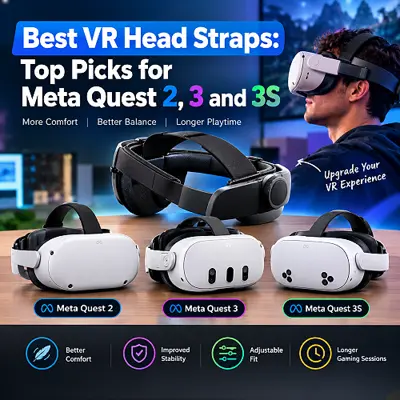
For users comparing other headset accessories, the best VR head straps may also be worth exploring separately. A head strap affects how the headset sits on the head, while prescription inserts correct vision, so check that the selected accessories fit together properly.
Best Reloptix VR Prescription Lens Inserts – Reloptix Magnetic Lens Kit
Reloptix is a strong option for users who prefer a magnetic prescription lens system. Its Quest 3 kit includes magnetic mounting bases and prescription lens frames, allowing the corrective lenses to be detached without repeatedly removing the bases from the headset.
The manufacturer lists anti-glare lenses, a hard storage case, protective microfiber bags, and a cleaning cloth among the kit’s included items.
Why consider it?
- Magnet-based removal makes cleaning and sharing easier.
- The inserts can be kept safe from damage in the storage case when not in use.
- Customizable prescriptions help those unable to use a regular non-prescription frame.
- The modularity can be advantageous for frequent VR users.
Best for:
Quest 3 owners who value removable lenses and want a dedicated prescription kit.
Important limitation:
Make sure you select the kit for your exact headset and prescription. Do not buy an extra-frame replacement by mistake; replacement frames may not include the magnetic bases needed for first-time installation.
Best Zenni Optical VR Prescription Lenses – Meta Quest 3
The Meta Quest 3 prescription lenses by Zenni Optical would be a practical choice for consumers who seek a straightforward solution. It is a lens that is supposed to clip into the headgear and offers single vision lenses with anti-scratch and anti-reflective coatings.
Advantages
- An easy to install product that does not require any special tools.
- Offering prescription correction where applicable.
- Special coatings that may protect against scratching and reflecting.
- Come in a carrying case for storage in-between uses.
Useful for:
Users of the Quest 3 who require a reasonably priced prescription solution.
Notes:
This particular product is meant for single vision correction. Make sure to check the prescription options available before making a purchase.
Best VR Optician Prescription Lens Inserts – Multi-Headset Options
You should consider using VR Optician if you have a headset that does not belong to the Quest series. Officially, VR Optician offers its products for prescription lenses for all headsets in the Meta Quest series,
The key benefit here is the possibility to purchase the lens product that is specifically made for the particular headset instead of finding a solution in frames for some other device. Users can choose their device and look at the available prescription lenses.
Reasons to choose this site
- Support for several VR headset families.
- Configurations of products for different optics.
- Prescription-based order.
- A choice for people who want to compare solutions for their particular device from one provider.
Suitable for:
Owners of Valve Index, PSVR2, HP Reverb G2 or Meta Quest headset series.
Best VR Wave Prescription Lens Inserts – Quest 3 and Other Supported Headsets
Prescription lenses are available for the following headsets through the VR Wave website: Meta Quest 3, Valve Index, HP Reverb G2, and PSVR2. Optical processing and special coating technologies for lenses that provide optimal visual perception are mentioned as some of the benefits of products from VR Wave.
Considerations
- Identify the product for a specific headset.
- Assess the available coating options.
- Determine whether magnetic mounts are included or sold separately.
- Evaluate shipping charges and returns policy before making an order.
Ideal for:
People using VR who are interested in trying out different lens configurations and ways of mounting them.
Limitation:
Final price will depend on the chosen product and additional features. Don’t refer to the price for the same product for a different headset.
Best Extra Frames Meta Quest 3 VR Prescription Lens Inserts – Reloptix Replacement Frames
Reloptix’s Extra Frames product is intended for users who already own the compatible magnetic mounting system and want an additional set of lens frames. It is not the same purchase as a complete first-time prescription kit.
The listed product includes a set of magnetic lens insert frames with anti-glare-coated lenses and protective microfiber bags. A limited lifetime warranty is also advertised. The product page specifically warns first-time buyers not to choose the extra-frames-only item because it does not include the magnetic base.
Main advantages
- A convenient option for an existing compatible Reloptix setup.
- Additional frames can simplify switching between supported prescription configurations.
- Protective bags help keep spare lenses covered during storage.
Best for:
Existing Reloptix owners who need replacement or additional frames.
Limitation:
It is not the right choice for a first-time buyer who needs the complete mounting system. Confirm compatibility with your existing bases before ordering.
Best PSVR2 VR Prescription Lens Inserts – PlayStation VR2-Specific Options
There are dedicated prescription lenses by VR Optician, VR Wave, and VR Lens Lab for PSVR2. These companies have headset-specific lenses rather than those inserts that work with the Meta Quest family.
When it comes to playing video games on consoles, a proper fit is important since the headset moves around when you rotate your head. Therefore, the insert must be able to stay in place without obstructing the lenses and face interface of the headset.
Features to look for
- Ability to accommodate both eyes.
- Secure mounting system.
- Anti-reflective and anti-scratch coating.
- Bags/case for storage.
- Installation/removal instructions.
Best suited for:
PSVR2 owners looking to use corrective lenses for console-based virtual reality experience.
Note:
Quest accessories are not compatible with PSVR2 inserts. Check the exact model of PSVR2 and their prescription lenses.
What to Look for in the Best VR Prescription Lens Inserts
Selecting the right product will mean more than just choosing the right brand name. The factors such as prescription strength, lens customization, the type of coatings, fit and cost will influence how well you wear your glasses.
Prescription Strength and Lens Customization
The first requirement is the availability of insert that can support your present prescription for distance. The majority of the custom lens producers will require that you give sphere, cylinder and axis values, if any.
Consider the following while making the order:
- Availability of single-vision support lenses.
- Myopia and Astigmatism lenses’ highest and lowest SPH and CYL values.
- Custom made lenses in case of higher values.
- Accuracy of prescription values including eye side and polarity of the values.
Do not use the same values from previous prescription, unless you have checked if those values still hold true. Consult your eye care specialist if you find that you have different eyesight now.
Magnetic vs. Snap-In VR Lens Inserts
- Both magnetic and snap-in systems have their benefits; one does not automatically beat the other.
- Magnetic systems employ magnets to secure the lens frames to compatible bases. They may facilitate easy detachment of the lenses in cases of cleaning or changes from one person to another.
- Snap-in systems are mounted directly on the designated mounting locations on the headset. They may be easy to install and may benefit people who rarely detach their lenses.
- Go for magnetic inserts if frequent detachment of lenses is necessary. Snap-in systems will be adequate if you use the headset alone and infrequently remove the lenses.
- Whichever system you choose, be sure to follow the manufacturer’s instructions and not force the frame in its mount.
Optical Clarity and Lens Coatings
- Lens coatings help in protecting the lenses as well as in enhancing their usability. Their benefits vary depending on the type of coating and insert application.
- Anti-reflective coating: Provides protection against reflection of lights.
- Scratch-resistant coating: Offers protection against normal wear and tear but doesn’t make the lens scratch proof.
- Anti-fog coating: Provides protection against fogging during exercise.
- Oil-resistant coating: Reduces fingerprints and provides ease of cleaning.
Not all coatings are available with each item; some service providers provide you with a basic coating while some charge you extra for a better one.
Use a proper microfiber cloth and clean the inserts according to the instruction provided by your provider. Use no other type of fabric or chemical as that can ruin the coating.
For additional guidance on keeping headset optics safe, best VR lens protection options should be considered alongside careful cleaning, correct insert placement, and safe storage. Protective accessories cannot replace proper handling or guarantee that lenses will never be scratched.
Comfort, fit, and field of view
The low profile frame will ensure that there is more space available between the eye and the lenses of your headset. This is very important for people who like to keep their headset closer to their face.
Before purchasing, take into account:
- The secure fit of the frame without pressing on the facial interface;
- The space left for your eyes;
- The possibility to install the lenses without touching the original optical surfaces;
- The thickness of the required prescription lenses;
- The eye-relief adjustment of the headset.
The installation of additional lenses can narrow the field of view of the headset since it puts the eyes farther away from the optical lenses of the headset. It is different from model to model and depends on the prescription of the lenses and frame design. Thinner frame can be useful here, but it won’t ensure you a full original field of view.
Pricing, Warranty, and Included Accessories
The prices depend on the complexity of the prescription, the material of the lenses, the package of coatings, the mount system used, and the delivery destination.
As a general rule, compare the total price of checkout rather than the base price advertised. In some cases, a cheap frame can not provide you with prescription lenses or extra-frame with mounting bases.
Make sure that the following elements are included in the order:
- Lenses for both left and right eyes.
- The complete set of mounting equipment.
- A protective case or storage bags.
- A cleaning cloth.
- Warranty and replacement policy.
You should also pay attention to shipping times and return policies. In case of custom prescription lenses, the return policy can differ from that applied to accessories and should be acceptable to you.
Installation and Maintenance of VR Prescription Lens Inserts
Correct installation and maintenance will guarantee clear vision and protect your headset’s original lenses from being damaged.
Installation of VR Prescription Lenses
- Get your headset ready. Power it down and put it on a clean and stable surface. Wash and dry your hands before starting to work with lenses.
- Examine the inserts. Note the markings and lens surfaces.
- Follow the correct installation method. Match the snap-in frames to the appropriate fitting or install magnetic frames on their respective bases.
- Press gently. Install the inserts as per the manufacturer’s guidelines. Do not force any frames that are not properly aligned.
- Verify the fit. Ensure that the inserts are firmly fixed and that they are not in contact with the original lenses of the headset.
- Put on the headset. Adjust the fit and lens distance (if there is any), and verify that the image is clear and comfortable.
In case the image is distorted or blurred, take off the headset and check if there are any installation issues. Do not use any frames that are not firmly fixed or appear to affect the optics of the headset.
How to Clean and Store VR Prescription Lens Inserts
Use a clean microfiber cloth designed for optical lenses. In case you are allowed by the manufacturer to use any cleaning liquid, use it as per the manufacturer’s instructions.
To make maintenance safer:
- Detach any removable inserts from the lenses before cleaning as advised by the manufacturer.
- Grip the frame and not apply pressure on the lenses’ surface.
- Avoid the use of paper towels, abrasive cloths, and abrasive cleaning agents.
- Maintain dryness on the lenses before putting them back.
- Keep detached inserts in the protective boxes.
- Avoid storing the headset and its inserts near dirt, excess heat, and exposure to sunrays.
Avoid placing the headset in places where the sunlight passes from the optical lenses to the display of the VR headset. Sunrays may even damage the display even if the headset is powered off.
When comparing accessories and checking product listings, the Pro Tech Base online store is one place readers can visit to explore available technology products. Always review the specific product details, compatibility information, and seller terms before purchasing.
Frequently Asked Questions
What Are VR Prescription Lens Inserts?
These are customized corrective lenses that will fit into a compatible VR headset. The lenses make it possible for users to view the display from the virtual world without having to wear any eyeglasses.
Are VR Prescription Lens Inserts Worth It?
They may be worth it in situations where wearing glasses causes discomfort, interferes with the fit of the headset, or touches the lenses that come originally with the headset.
Do VR Prescription Lens Inserts Work With Meta Quest 3?
Yes. There are several brands of prescription lenses for Meta Quest 3 available. Some of them include Zenni Optical, Reloptix, VR Optician, VR Wave, and VR Lens Lab.
Can You Use Quest 2 Prescription Lens Inserts on Meta Quest 3?
In most cases, you should not make this assumption. The Quest 2 and the Quest 3 feature distinct optical systems and lens mounting mechanisms. Buy only the inserts that are explicitly meant for the Quest 3.
Do Astigmatic Prescription Lens Inserts Exist for VR?
Yes, plenty of manufacturers can provide prescription lens inserts with the necessary parameters, including sphere, cylinder, and axis. Make sure your prescription is within the limits supported by the provider in advance.
Are Magnetic VR Prescription Lens Inserts More Advantageous?
Magnetic inserts are handy if you often take out your lenses for cleaning or because you share the VR headset with another person. In other cases, snap-in inserts may be a good choice for you. It all comes down to your preferences and the quality of the inserts.
Are You Able to Wear VR Prescription Lens Inserts With Glasses?
It might be technically possible, but there will be no need to do so since prescription lens inserts are expected to replace your glasses while wearing the headset.
Do VR Prescription Lens Inserts Protect Headset Lenses From Scratches?
These inserts can aid in preventing the likelihood of contact between the eyeglasses and original headset lenses. Nonetheless, the inserts themselves could scratch the optical components of the headset should they be improperly fit, handled, or just plain incompatible with your device. Ensure proper spacing in accordance to the instructions.
How Much Are VR Prescription Lens Inserts Priced At?
The cost varies based on the manufacturer, the specific headset being used, the prescription required, coatings applied, and type of mount chosen. For instance, Zenni sells their Quest 3 lenses at $49.99, while Reloptix, VR Optician, and VR Lens Lab sell theirs at different prices. These prices may vary.
Do You Have VR Prescription Lens Inserts for Valve Index and PSVR2?
Yes. There are dedicated products from VR Optician and VR Wave for the two devices, and PSVR2 is listed by VR Lens Lab. Make sure that you select the right headset model.
Final Thoughts
Selecting the appropriate Best VR Prescription Lens Inserts will help to enhance the experience with VR if you require visual correction. The critical factor here is the choice of the right lens insert corresponding to the exact model of your headset – Meta Quest 3, Quest 3S, Quest 2, Valve Index, HP Reverb G2, or PlayStation VR2.
The key factors that should be compared when choosing the Best VR Prescription Lens Inserts are prescription support, lens coating, type of mounting, eye clearance, and overall price. Magnetic systems will offer convenience when using removable frames frequently, while fixed snap-in solutions will be appropriate for those who don’t have to change the settings often.
One of the options that can be taken into account is FICEP Q3 Magnetic Lens Frame for users of the Quest 3 headset who are interested in a removable lens insert. However, before the purchase, it is necessary to find out whether this particular product comes with custom prescription lenses or you need to order additional lenses.
Finally, check all the current characteristics, including warranty, delivery terms, and compatibility of the lens insert with your headset model. Inappropriate VR prescription lens inserts will be less useful than an inexpensive accessory that won’t suit your needs. Readers can also explore the Pro Tech Base online tech store for available technology products.