
VR headsets tend to get very uncomfortable after prolonged usage due to the heating up and sweating of the facial skin. Best VR Face Covers can provide an improved surface while facial interfaces also assist with airflow, light filtration, and a better fit.
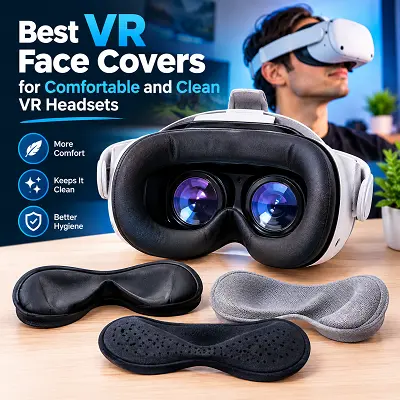
Face covers normally cover the already existing facial interface while replacement pads are used as alternatives to the cushions. Each one of these materials offers some kind of benefit in terms of comfort, sweating control, and cleansing. It is necessary to remember that the mask which is supposed to fit for Quest 2 may not necessarily work for Quest 3 or Quest 3S.
What Are VR Face Covers?
VR Face Cover is a device worn on the part of the VR headset that comes in contact with the face. Its use depends on the design, and it may cover, replace, or become part of the whole facial interface of the VR headset.
The function of the VR face cover is mainly providing comfort and hygiene of the place where the device comes into contact with your face. Additionally, some designs provide special ventilation or a special nose part.
VR Face Cover vs VR Face Pad
- VR Face Cover: Worn over the facial interface and is made up of materials such as silicone and cotton.
- VR Face Pad: The cushion which comes into contact with your face and can be replaced.
- Facial Interface: Entire assembly of the face cushion and the VR headset.
- Replacement Interface: Can help to enhance cushioning, ventilation, fit and light blockage.
- Important: Check if you just need a cover, replacement pad or the entire facial interface.
Why Use a VR Face Cover?
A face cover can be useful for several reasons:
- Creates a cleaner surface between the headset and your skin
- Helps manage sweat during active VR use
- Makes cleaning easier
- Can improve comfort compared with worn or compressed padding
- May improve light blocking depending on its shape
- Can make shared-headset use more hygienic
- Gives an alternative material in case the original material does not work for you
In case of active play, washable silicone could be very handy. In case of prolonged use, soft PU leather or fabric might work better. A best online tech store for shoppers can also make it easier to compare compatible options.
What Is a Good VR Face Cover?
A good cover is one that fits your headset precisely and does not interfere with the lenses and sensors. A good cover is one that:
- Correct headset compatibility
- Comfortable face-contact material
- Secure attachment
- Suitable padding thickness
- Good ventilation
- Easy cleaning
- Effective light blocking
- A design that matches your type of VR use
A comfortable cover which is not a good fit will also be a problem for prolonged use.
What Materials Can You Find VR Face Covers Made of?
Not all materials are suitable for all types of virtual reality users. There is no universal material suitable for everyone using this technology.
VR Face Covers Made of PU Leather
This type of material is quite common for VR covers because it allows you to get a surface easy to clean. It is important to remember that the material doesn’t absorb sweat like fabrics.
It may be helpful for people who often use the virtual reality headsets or share them with other users. The drawback of this material is its higher temperature compared to fabric while exercising.
VR Covers Made of Silicone
It is one of the best choices for exercising as this material is easy to clean and doesn’t let sweat pass through. It can be used for playing sports video games, fitness training, and sharing the device. Those people who want more comfortable and soft material for their faces will find something else.
Cotton VR Face Covers
The cotton cover serves to offer the user a more soft and breathable surface. They are also washable and reusable and can be very beneficial to those users who favor fabric over silicone or PU leather. They absorb sweat well, although they require washing often since sweat remains in the material.
Disposable VR Face Covers
Disposable covers are mainly designed for hygiene. They create a temporary barrier between the user’s face and the headset and are especially useful when many people use the same device.
For instance, AMVR’s hygienic VR eye mask is made of soft nonwoven fabric and comes packed with 100 pieces per pack suitable for shared headsets. The brand claims that the VR hygiene masks can work well with Quest, PICO, Gear VR, HTC Vive, PlayStation VR, and other headsets.
Full VR Facial Interfaces vs Replacement Pads
A replacement pad changes the cushioning while a full facial interface can replace the complete frame and padding assembly.
Choose a full interface when you want changes to:
- Padding shape
- Ventilation
- Light blocking
- Face-to-lens distance
- Attachment system
- Overall fit
Use either a cover or a replacement pad if the initial interface works well for you, and you just need to increase your hygiene or change the contact material.
How VR Face Covers Increase Comfort and Hygiene
The face is one of the areas that may become the hottest place in the helmet. Thus, the material selection and its ventilation are directly related to your comfort.
How Do VR Face Covers Deal With Sweat
During playing fitness games and moving actively, sweat can gather on the facial interface. Silicone and PU leather interfaces are easy to wipe and thus provide better cleaning options.
Fabric covers use another solution: they absorb sweat. It can be comfortable during exercising; however, you should wash them periodically because of sweat accumulation.
How VR Face Covers Help Reduce Lens Fogging
This phenomenon occurs whenever warm and humid air touches the relatively cool lens area. A face cover does not necessarily mean that the fogging will be prevented, but a well-ventilated facial interface could help with better airflow over the face.
For instance, the KIWI V3 Facial Interface for Quest 3 utilizes L-shape vents along with the upper and lower grill to facilitate air movement and reduce the heat buildup in the face area and prevent lens fogging.
How Do VR Face Covers Help With Maintaining Hygiene of the Headset
The area of the face comes into direct contact with sweat, oils from the skin, makeup, and dust. A washable cover creates an additional layer which can be easily washed. Disposable covers are helpful especially when there is a need to share a headset among several users.
How VR Face Covers Help During Long Gaming Sessions
Prolonged use increases the strain on the cheeks, forehead, and nose region. Increased width of the cushion will help disperse the pressure on a larger area rather than confining it to a small area.
The thickness of the cushion is also important to consider. Insufficient thickness of the cushion makes the face cover hard to wear, whereas too much cushioning may affect the distance between the user’s eyes and the lenses.
How to Select the Best VR Face Cover?
It is more about the compatibility and usability than about aesthetics.
VR Headset Compatibility Check
Compatibility with the specific VR headset needs to be checked always before purchasing. For example, the face interface of Quest 2, Quest 3, and Quest 3S differ, so the cover that was made specially for one generation of the device may not fit another one. The same principle is true for HTC Vive and Samsung Gear VR.
Choose the Right Material and Padding
Think about your headset usage:
- Silicone: helps with sweat and easy to clean
- PU leather: soft, easily wiped off, and appropriate for everyday use
- Cotton: breathability and absorbency
- Foam: comfortable and common, but requires more thorough cleaning
- Non-woven disposable material: convenient for communal use
The cushioning should be sufficiently supportive without being too pressuring.
Ventilation and Light Sealing
Increased ventilation will be useful to let the heat and moisture out; however, the holes should not cause extra light seeping.
In case of immersion requirements, find a headset that features a formed nose section with facial contours. If cooling is the key feature you require, then go for air channels interfaces.
Choose a Cover Based on Your Gaming Style
While gaming normally, comfort and easy cleaning could be what matters most when using the best VR headsets for gaming. When doing VR fitness, sweat resistance and ventilation will become crucial.
For shared headsets, easy cleanability or disposability of the cover will come into play. For prolonged simulations or adventures, padding, pressure distribution, and light blockage will require special attention.
Think About Cleaning and Maintenance
A cover that will be hard to clean may become inconvenient despite initial comfort. Silicone or smooth PU leather are usually easy to wipe off. Cotton covers can usually be washed in accordance with manufacturer’s instructions. Disposability covers just have to be changed.
Best VR Face Covers for Various VR Headsets
Compatibility has to be taken into account prior to choosing material or considering the cost.
VR Headset Face Covers for Quest 2
Quest 2 has a large range of replacement interfaces and covers. The Meta VR Cover Facial Interface & Foam Replacement Set, for example, uses a facial-interface frame with PU leather foam replacements and ventilation channels.
Cotton covers are another option for Quest 2 users who want a washable layer over the original interface.
VR Headset Face Covers for Quest 3 and Quest 3S
Quest 3 and Quest 3S models have different accessory designs, and it would be wrong for someone to buy a Quest 3 cover as Quest 3S cover.
Meta has a Quest 3 Facial Interface and Head Strap and also a Quest 3S Breathable Facial Interface on their list of official accessories. Users can also compare these options with best VR head straps for different headset setups.
VR Headset Face Covers for Vive
The HTC Vive has its unique designs for the facial interface. The HTC VIVE XR Elite PU Leather Gasket is a replacement for the original gasket which is used to replace the old gasket in order to maintain the facial seal.
Gear VR Face Covers
The Samsung Gear VR accessories depend on the model of the VR device and thus, buyers need to establish the Gear VR model first before buying a cover. Disposable VR hygiene covers are an easy option for shared Gear VR since there are some products that are compatible with many headsets.
Gear VR Face Pad Covers
A Gear VR face pad cover will come in handy especially if the original interface still works well but it needs a cleaner or healthier surface. Universal covers can be helpful when demonstrating or using the VR device in a shared environment.
Best VR Face Covers for 2026
Looking for the Best VR Face Covers in 2026? The following options cover different needs, including comfort, sweat protection, ventilation, hygiene, and headset compatibility, rather than trying to make every option serve the same purpose.
For shoppers comparing these options, Pro Tech Base online tech store can also be a place to browse related technology accessories.
Best VR Face Cover for Quest 2 – Meta VR Cover Facial Interface & Foam Replacement Set
The Meta VR Cover Facial Interface & Foam Replacement Set is designed for Quest 2 and combines a replacement interface with PU leather foam options. It includes standard and comfort foam replacements, giving users more than one cushioning choice.
Product Details
- Type: Full facial interface and foam replacement
- Material: PC-ABS, memory foam, and PU leather
- Ventilation: Anti-fog airflow channels
- Installation: Replacement interface installation
- Compatibility: Meta/Oculus Quest 2
The PU leather surface is useful for users who want a smooth contact area that can be wiped clean. The removable nose guard also helps with the facial seal.
Pros
- Complete interface replacement
- Two foam options
- PU leather surface
- Designed specifically for Quest 2
Cons
- Only suitable for compatible Quest 2 setups
- More involved than simply fitting an outer cover
- Not designed for Quest 3 or Quest 3S
Our Verdict
A practical full-interface choice for Quest 2 owners who want to change both the frame and facial cushioning.
Comfortable VR Face Cover for Quest 2 – KIWI Design Facial Interface and Face Pad
The Comfortable VR Face Cover for Quest 2 from KIWI design combines a facial interface with a wide PU leather cushion. Its L-shaped vents and upper and lower grilles are designed to improve airflow and help reduce heat and lens fogging.
Key Details
- Type: Replacement facial interface and face pad
- Material: PU leather cushion
- Fit: Designed for Quest 2
- Comfort: Wide cushion distributes pressure
- Hygiene: Sweat-resistant surface can be wiped clean
The interface also includes removable nose pieces for light control. Installation is designed to be quick, which is useful for users who regularly remove the interface for cleaning.
Pros
- Wide cushioning
- Ventilation design
- Wipe-clean surface
- Quick installation
Cons
- Quest 2 specific
- PU leather may feel warmer than fabric during intense exercise
- Replaces more components than a simple cover
Our Verdict
A suitable choice when comfort, ventilation, and easier cleaning matter more than using the smallest possible accessory.
VR Face Cover for Active Gaming – AMVR Q3FC1 Ventilated Facial Interface
The VR Face Cover for Active Gaming from AMVR is designed for Meta Quest 3 and includes both PU leather and ice silk cotton face-pad options. Its ventilation structure uses grills on the top, bottom, and sides to encourage airflow.
Key Details
- Ventilation: Top, bottom, and side ventilation
- Sweat protection: PU leather option
- Secure fit: Adjustable facial-interface depth
- Active movement: Breathable ice silk cotton option
- Compatibility: Meta Quest 3
The cotton option is particularly useful for exercise because it is designed to absorb moisture, while the PU option offers a smoother surface that is easier to wipe.
Pros
- Multiple pad materials
- Adjustable depth
- Ventilated structure
- Useful for active VR
Cons
- Designed for Quest 3
- More expensive than a simple silicone cover
- Some setups may have charging-dock compatibility limitations
Our Verdict
A flexible Quest 3 solution for users who switch between everyday gaming and more active sessions.
Best Cotton VR Face Cover for Quest 3 – AMVR Ice Silk Cotton Facial Interface
The Best Cotton VR Face Cover for Quest 3 is the AMVR ice silk cotton facial-interface option. It is designed to provide a breathable, moisture-wicking surface for users who prefer fabric over silicone or PU leather.
Key Details
- Cotton material: Breathable ice silk cotton
- Washability: Can be gently washed
- Sweat absorption: Designed to absorb moisture
- Quest 3 compatibility: Designed for Meta Quest 3
The fabric needs more careful maintenance than silicone. AMVR recommends gentle washing and avoiding harsh scrubbing to reduce the risk of damaging the fabric surface.
Pros
- Breathable material
- Moisture-wicking design
- Comfortable for active use
- Washable
Cons
- Requires regular washing
- Fabric can retain moisture
- Quest 3 specific
Our Verdict
A good fit for users who prefer breathable fabric and sweat absorption during longer or more active sessions.
Disposable VR Face Cover for Hygiene – AMVR Disposable VR Hygiene Eye Masks
The Disposable VR Face Cover for Hygiene is designed for situations where many people use the same headset. AMVR offers a 100-piece pack made from soft non-woven material.
Key Details
- Disposable material: Soft non-woven fabric
- Shared headset use: Designed for multiple users
- Breathability: Lightweight fabric construction
- Hygiene: Creates a temporary barrier against sweat, oil, makeup, and dirt
These covers are especially relevant to VR arcades, gaming cafés, demonstrations, exhibitions, and workplaces where cleaning the headset between every user can be inconvenient.
Pros
- Large 100-piece pack
- Broad headset compatibility
- Convenient for shared use
- Single-use hygiene solution
Cons
- Creates ongoing consumable cost
- Not intended as a permanent replacement pad
- Less cushioning than a full facial interface
Our Verdict
A practical hygiene-focused solution for shared VR environments.
Budget VR Face Interface for Quest 2 – KIWI Design Facial Interface and Face Pad
The Budget VR Face Interface for Quest 2 is another useful category for users who want a complete interface rather than only an outer cover. The KIWI Quest 2 interface combines a replacement frame with a wide cushion, ventilation, and removable nose pieces.
Key Details
- Full interface design: Replacement facial interface
- Padding: Wide PU leather cushion
- Ventilation: L-shaped vents and grilles
- Light seal: Removable nose pieces
- Installation: Snap-in replacement design
For a Quest 2 owner whose original interface is worn or uncomfortable, a full replacement can make more sense than buying several separate covers.
Pros
- Complete replacement design
- Ventilation
- Pressure-distributing cushion
- Easy cleaning
Cons
- Model-specific
- Not a universal VR interface
- PU surface may not suit users who prefer fabric
Our Verdict
A sensible complete-interface route for Quest 2 users who need a practical replacement rather than a disposable cover.
PU Leather VR Face Cover for Quest 2 – Meta VR Cover Foam Replacement
The PU Leather VR Face Cover for Quest 2 is suited to users who want a smooth, wipeable facial-contact material. The Meta VR Cover replacement set uses PU leather foam replacements and includes standard and comfort versions.
Key Details
- PU leather: Smooth facial-contact surface
- Cleaning: Easier wipe-down maintenance
- Sweat resistance: Better suited to moisture than absorbent fabric
- Padding: Memory foam choices
- Fit: Designed around the Quest 2 interface
Pros
- Easy surface cleaning
- Multiple foam options
- Useful for frequent users
Cons
- Quest 2 specific
- Can feel warmer than cotton
- More than a basic slip-on cover
Our Verdict
A useful material-focused choice when easy cleaning is a priority.
Disposable VR Face Covers for Shared Headsets – Knox VR Face Cover
The Disposable VR Face Covers for Shared Headsets from Knox are made from soft spun-lace material and are intended for shared VR use. The manufacturer lists compatibility with Meta Quest 3/3S, HTC Vive, Oculus Rift, Samsung Gear VR, Google Daydream, and Google Cardboard.
Key Details
- Pack size: 50 pieces
- Compatibility: Multiple VR headset families
- Hygiene: Single-use facial barrier
- Shared-use applications: Friends, demonstrations, and shared headsets
Pros
- Multi-headset compatibility
- Disposable design
- Useful for shared equipment
Cons
- Requires replacement after use
- Does not provide full interface cushioning
- Not a solution for damaged facial interfaces
Our Verdict
A convenient option when hygiene between multiple users is the main concern.
Silicone VR Face Cover for Sweat Protection – AMVR Sweatproof Silicone Face Cover for Quest 3
The Silicone VR Face Cover for Sweat Protection is designed for Quest 3 and fits over the original facial interface. AMVR describes it as a washable silicone cover intended to resist sweat and dust.
Key Details
- Silicone construction: Smooth, washable surface
- Waterproof/sweat barrier: Helps keep moisture away from the original pad
- Comfort: Soft silicone contact surface
- Installation: Fits over the existing interface
- Active-use limitations: Less absorbent than cotton
Its simple design makes it different from a full replacement interface. You can keep the original frame while adding a washable outer layer.
Pros
- Easy cleaning
- Sweat-resistant surface
- Simple installation
- Quest 3 specific fit
Cons
- Does not replace the complete interface
- Silicone may feel warmer to some users
- Designed for the original/compatible interface setup
Our Verdict
A straightforward choice for Quest 3 users who mainly want easier sweat management and cleaning.
VR Face Pad for Quest 3S – KIWI Design F4 Silicone Facial Cover
The VR Face Pad for Quest 3S from KIWI design is specifically made for the Meta Quest 3S and is not compatible with the Quest 3. It uses soft silicone and is designed for active and extended sessions.
Key Details
- Quest 3S compatibility: Quest 3S only
- Material: Soft-touch silicone
- Ventilation: Facial contour allows a close fit
- Padding: Flexible silicone contact layer
- Light seal: Built-in nose area helps reduce light leakage
The washable construction makes it suitable for users who sweat during games or regularly share the headset.
Pros
- Quest 3S-specific design
- Washable
- Sweat-resistant
- Flexible fit
- Light-blocking contour
Cons
- Not compatible with Quest 3
- Silicone is less absorbent than cotton
- Fit can feel different depending on face shape
Our Verdict
A practical Quest 3S choice for users who want a washable silicone surface without replacing the complete headset.
VR Face Covers by Material and Design
Material selection is one of the easiest ways to narrow down your choices.
PU Leather VR Face Covers
PU Leather would be ideal if ease of cleaning, sweat resistance, and surface smoothness were your top concerns. PU Leather could be used by someone who regularly uses a VR headset, as well as sharing one.
Silicone VR Face Covers
Silicone would be especially useful for users that sweat a lot. It does not hold water and can be cleaned. It just needs one check point, and that is whether you like it or not.
VR Face Masks made with Cotton
It will be more suitable for the one who prefers air and water retention. Cotton masks need cleaning after every use.
Disposable VR Face Covers
Disposable covers make the most sense for shared headsets. They are not intended to replace a damaged interface or provide the cushioning of a full face pad.
VR Covers Leather Pad Face Ring
The use of leather pads or face rings generally refers only to the soft facial interface part and not the outer shell of the headset. The leather pads can include PU leather along with memory foam to ensure comfort as well as easy cleaning. It is necessary to think about whether one would like to buy the pad alone or a complete facial interface pack.
Best VR Face Covers for Various VR Requirements
There are various requirements for different VR activities that the facial interface should satisfy.
Best VR Face Covers for Extended Gaming Sessions
Consider pressure dispersion and padding when selecting covers for extended gaming sessions. It is helpful to have a broad pad for more significant contact area and venting to dissipate heat.
Best VR Face Covers for Active VR and Sports
When playing sports or fitness VR games, you should also think about sweat prevention. Silicone and washable PU interfaces are very handy; breathable cotton may also work.
Best VR Face Covers for Shared Headsets
The shared-use devices should have easy-to-clean surfaces or barriers that are disposable. One may replace a non-woven cover between users while the whole facial interface will not be replaced.
Best VR Face Covers for More Efficient Sweat Protection
S The material which is water resistant is ilicone while the one which is wipe-able is PU leather. The third material cotton is different because cotton material takes away sweat but it needs cleaning after some time.
Cleaning of VR Face Covers
It is one of the most crucial parts in keeping the face cover clean and extend its life span when it is reusable.
Cleaning of PU Leather VR Face Covers
Just wipe it with a damp cloth.If it is not recommended by the manufacturer, you should not wash the foam part below, which is covered with the PU leather. Once cleaning is done, make sure it is completely dried before using it again.
How to Clean Silicone VR Face Covers
Silicone is the easiest material among others to take care of. You need to remove the cover if possible, then clean and dry it according to the manufacturer’s recommendations.
How to Wash Cotton VR Face Covers
Cotton covers should be cleaned in accordance with the care instructions provided in the manual. It is better to wash the cover gently, taking into consideration specific types of material such as ice silk cotton. AMVR suggests washing its Quest 3 cotton pad gently and advises not to scrub it hard enough as it might damage the cover’s surface.
Frequently Asked Questions
For what purpose is a VR face cover used?
The VR face cover is used to create a clean and comfortable surface between your face and a headset. Depending on its type, it might have additional functions as well.
Are VR headset face covers universal?
No. They are intended for certain headsets only. The accessories for Quest 2, Quest 3, and Quest 3S must be verified separately.
Do VR face covers of Vive work with other headsets?
Typically, no. The design of Vive facial interfaces depends on the sizes and mounting points of particular Vive models.
Are Gear VR face pads compatible with all headsets?
No. Different models of Gear VR have different designs. There are universal disposable cover pads that are compatible with multiple headset families; however, a replacement facial interface must correspond to a certain model.
Which one is better – a VR face pad or a silicone cover?
This depends on the issue you need to solve. A face pad allows changing cushioning, whereas the silicone cover is suitable in case of good fit of the existing interface and need for improved sweat resistance.
Do VR face covers help with sweat?
No. They are intended for certain headsets only. The accessories for Quest 2, Quest 3, and Quest 3S must be verified separately.
Do VR face covers of Vive work with other headsets?
Typically, no. The design of Vive facial interfaces depends on the sizes and mounting points of particular Vive models.
Are Gear VR face pads compatible with all headsets?
No. Different models of Gear VR have different designs. There are universal disposable cover pads that are compatible with multiple headset families; however, a replacement facial interface must correspond to a certain model.
Which one is better – a VR face pad or a silicone cover?
This depends on the issue you need to solve. A face pad allows changing cushioning, whereas the silicone cover is suitable in case of good fit of the existing interface and need for improved sweat resistance.
Final Thoughts
The decision will depend on the fit, material, comfort, ventilation, hygiene, and gaming application. Those using the Quest 2, Quest 3, Quest 3S, Vive and Gear VR need to identify their models first before starting the comparison of materials and designs. If you are going to game for hours, look at the comfort in the material used, and if you are into fitness and active VR, washable silicone, PU leather or cotton will make it easier to maintain.
Disposability covers are recommended for shared headsets, as they are just providing hygiene. There is also an aspect that needs to be considered when choosing a facial interface or cover, and it is their application. Some of these accessories were created to provide comfort, some are sweat-resistant, some are easy to clean, while others provide good ventilation.
The best VR Face Covers are not always the costliest. Instead, it should match your exact model, fit well on your face and be suitable for your type of gaming and maintenance. The Pro Tech Base online store also offers related VR accessories for different headset setups.